> ## Documentation Index
> Fetch the complete documentation index at: https://docs.harborframework.com/llms.txt
> Use this file to discover all available pages before exploring further.
# Environment variables
> Control which environment variables reach Harbor, sandboxes, agents, and verifiers.
Harbor separates variables by where they are needed: the Harbor process, the
sandbox, the agent phase, or the verifier phase.
Keep sandbox-provider credentials such as `DAYTONA_API_KEY` in the Harbor
process. Passing them through `environment.env`, `--agent-env`, or
`--verifier-env` unnecessarily exposes them inside the sandbox and is **not
recommended**.
`export` and `--env-file` do not copy every variable into the sandbox. To pass
a host variable such as `DATABASE_URL`, set `environment.env.DATABASE_URL` to
`${DATABASE_URL}` explicitly.
The agent and verifier run in the same sandbox.
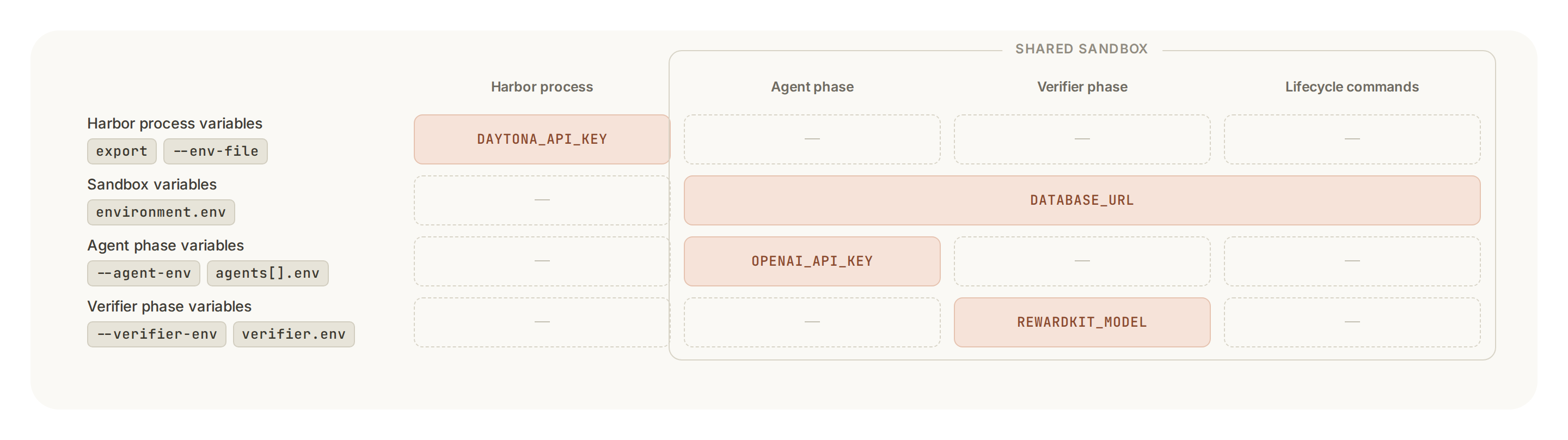 Lifecycle commands include health checks, step setup, and collection hooks.
They run around the agent and verifier phases and receive sandbox variables only.
| Scope and availability | Shell or CLI | `config.json` | `task.toml` | Example |
| - | - | - | - | - |
| **Harbor process** and environment provider | `export`, `--env-file` | — | — | `DAYTONA_API_KEY` |
| **Shared sandbox:** agent, verifier, and lifecycle commands | — | `environment.env` | `[environment.env]` | `DATABASE_URL` |
| **Agent phase only** | `--agent-env` (`--ae`) | `agents[].env` | — | `OPENAI_API_KEY` |
| **Verifier phase only** | `--verifier-env` (`--ve`) | `verifier.env` | `[verifier.env]` | `REWARDKIT_MODEL` |
Lifecycle commands include health checks, step setup, and collection hooks.
They run around the agent and verifier phases and receive sandbox variables only.
| Scope and availability | Shell or CLI | `config.json` | `task.toml` | Example |
| - | - | - | - | - |
| **Harbor process** and environment provider | `export`, `--env-file` | — | — | `DAYTONA_API_KEY` |
| **Shared sandbox:** agent, verifier, and lifecycle commands | — | `environment.env` | `[environment.env]` | `DATABASE_URL` |
| **Agent phase only** | `--agent-env` (`--ae`) | `agents[].env` | — | `OPENAI_API_KEY` |
| **Verifier phase only** | `--verifier-env` (`--ve`) | `verifier.env` | `[verifier.env]` | `REWARDKIT_MODEL` |
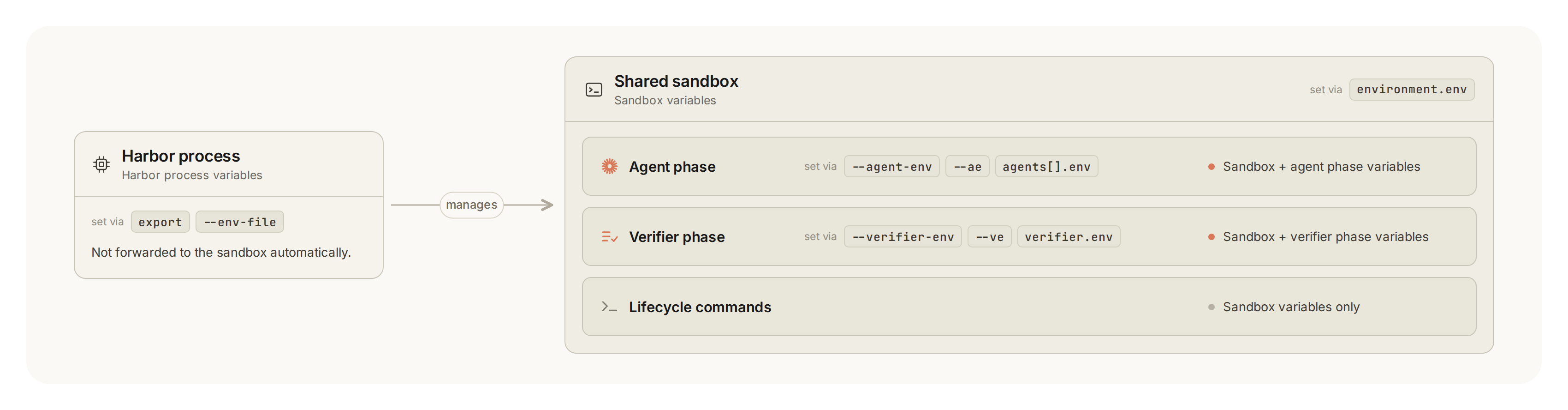 The agent, verifier, and lifecycle commands share one sandbox. Phase
variables are added only while their phase runs and override sandbox
variables with the same name.
A [separate verifier](/tasks/separate-verifier) runs in a
second sandbox. Agent-phase variables do not reach it; only
[collected artifacts](/jobs/artifact-collection) cross from
the agent sandbox.
The agent, verifier, and lifecycle commands share one sandbox. Phase
variables are added only while their phase runs and override sandbox
variables with the same name.
A [separate verifier](/tasks/separate-verifier) runs in a
second sandbox. Agent-phase variables do not reach it; only
[collected artifacts](/jobs/artifact-collection) cross from
the agent sandbox.
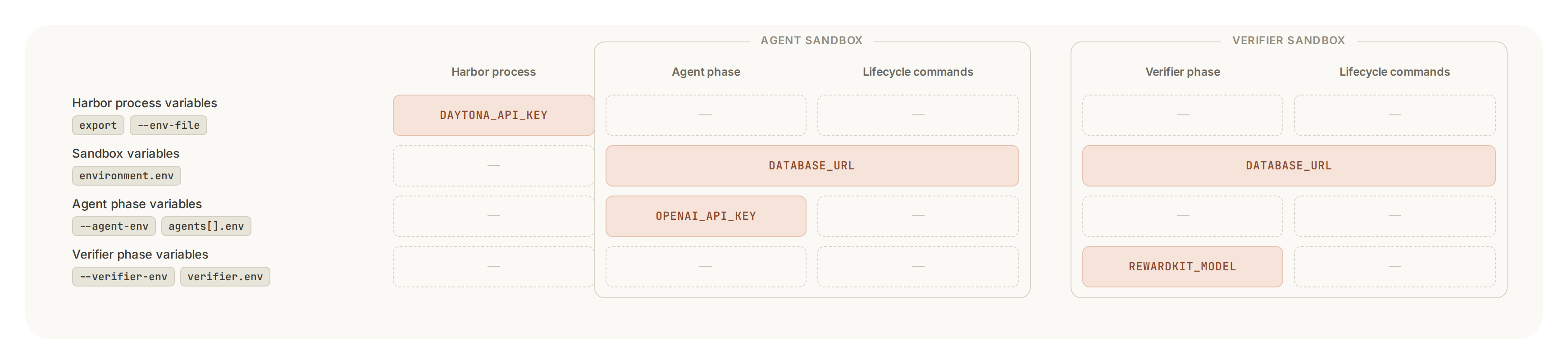 `verifier.environment.env` sets baseline variables for the verifier sandbox,
including its lifecycle commands. `verifier.env` adds variables only during
the verifier phase.
| Scope and availability | Shell or CLI | `config.json` | `task.toml` | Example |
| - | - | - | - | - |
| **Harbor process** and environment provider | `export`, `--env-file` | — | — | `DAYTONA_API_KEY` |
| **Sandbox baseline** | — | `environment.env` (both sandboxes) | `[environment.env]` (agent sandbox) | `DATABASE_URL` |
| **Agent phase only** | `--agent-env` (`--ae`) | `agents[].env` | — | `OPENAI_API_KEY` |
| **Verifier phase only** | `--verifier-env` (`--ve`) | `verifier.env` | `[verifier.env]` | `REWARDKIT_MODEL` |
`verifier.environment.env` sets baseline variables for the verifier sandbox,
including its lifecycle commands. `verifier.env` adds variables only during
the verifier phase.
| Scope and availability | Shell or CLI | `config.json` | `task.toml` | Example |
| - | - | - | - | - |
| **Harbor process** and environment provider | `export`, `--env-file` | — | — | `DAYTONA_API_KEY` |
| **Sandbox baseline** | — | `environment.env` (both sandboxes) | `[environment.env]` (agent sandbox) | `DATABASE_URL` |
| **Agent phase only** | `--agent-env` (`--ae`) | `agents[].env` | — | `OPENAI_API_KEY` |
| **Verifier phase only** | `--verifier-env` (`--ve`) | `verifier.env` | `[verifier.env]` | `REWARDKIT_MODEL` |
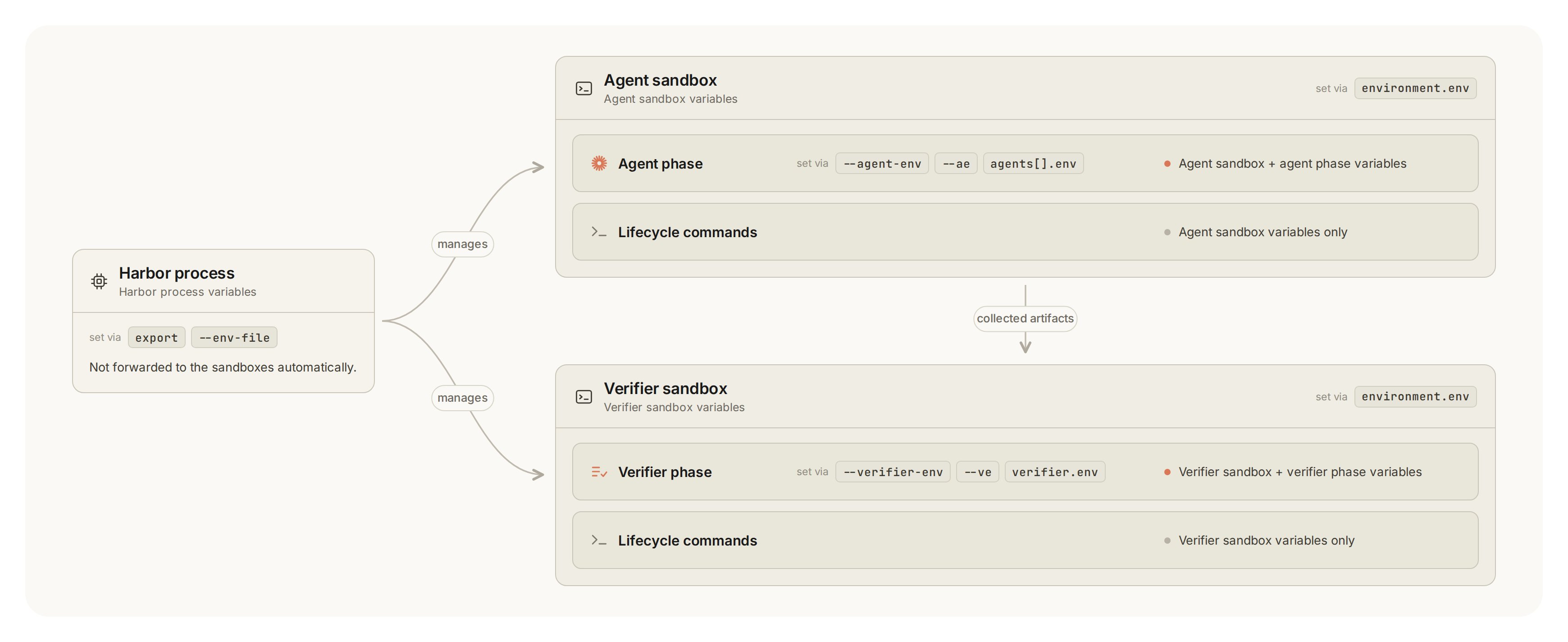 If separate mode is enabled without `[verifier.environment]`, Harbor
copies the top-level `[environment]`. Its `[environment.env]` variables
therefore become the verifier sandbox baseline as well.
Verifier-phase variables override verifier-sandbox variables with the same
name. Agent-phase variables follow the same rule in the agent sandbox.
## Automatic agent credential forwarding
Some [built-in agents](/agents/pre-integrated-agents) recognize
selected host variables automatically. For example, Codex reads
`OPENAI_API_KEY` from the Harbor process and makes it available during the Codex
agent phase. This behavior is agent-specific; unrelated host variables are not
forwarded.
These host credentials are available only during the named agent's phase.
Values passed with `--agent-env` take precedence.
| Agent | Recognized host credentials | Forwarded as |
| - | - | - |
| `codex` | `OPENAI_API_KEY` | `OPENAI_API_KEY` |
| `claude-code` | `ANTHROPIC_API_KEY`, `ANTHROPIC_AUTH_TOKEN`, or `CLAUDE_CODE_OAUTH_TOKEN`; for Bedrock, `AWS_BEARER_TOKEN_BEDROCK` or the standard AWS credential chain | `ANTHROPIC_API_KEY`, `CLAUDE_CODE_OAUTH_TOKEN`, or the original AWS variables |
| `gemini-cli` | `GEMINI_API_KEY`, `GOOGLE_API_KEY`, `GOOGLE_GENERATIVE_AI_API_KEY`, or `GOOGLE_APPLICATION_CREDENTIALS` | Google authentication variables |
| `antigravity-cli`, `antigravity-sdk` | `GEMINI_API_KEY`; `antigravity-cli` also recognizes `GOOGLE_API_KEY` | `GEMINI_API_KEY` |
| `copilot-cli` | `COPILOT_GITHUB_TOKEN`, `GH_TOKEN`, or `GITHUB_TOKEN` | `COPILOT_GITHUB_TOKEN` |
| `cursor-cli` | `CURSOR_API_KEY` | `CURSOR_API_KEY` |
| `fx` | `AI_GATEWAY_API_KEY`, `VERCEL_AI_GATEWAY_API_KEY`, or `VERCEL_OIDC_TOKEN` | Vercel AI Gateway authentication variables |
| `muse-code` | `META_API_KEY` | `META_API_KEY` |
| `openhands`, `openhands-sdk` | `LLM_API_KEY`; `openhands` also recognizes the provider credential selected by `-m` | `LLM_API_KEY` |
| `aider`, `goose`, `mcode`, `mimo`, `mini-swe-agent`, `opencode`, `pi`, `qwen-coder`, `swe-agent`, `trae-agent` | Credential for the provider selected by `-m` | Integration-specific provider variables |
Provider-dependent agents use Harbor's [provider credential
registry](https://github.com/harbor-framework/harbor/blob/main/src/harbor/agents/model_connection.py).
ACP registry agents do not use this automatic forwarding; pass their credentials
with `--agent-env`. Other integrations may recognize additional variables; check
the [agent implementation](https://github.com/harbor-framework/harbor/tree/main/src/harbor/agents/installed).
This documentation is built and hosted on [Mintlify](https://mintlify.com), a developer documentation platform.
If separate mode is enabled without `[verifier.environment]`, Harbor
copies the top-level `[environment]`. Its `[environment.env]` variables
therefore become the verifier sandbox baseline as well.
Verifier-phase variables override verifier-sandbox variables with the same
name. Agent-phase variables follow the same rule in the agent sandbox.
## Automatic agent credential forwarding
Some [built-in agents](/agents/pre-integrated-agents) recognize
selected host variables automatically. For example, Codex reads
`OPENAI_API_KEY` from the Harbor process and makes it available during the Codex
agent phase. This behavior is agent-specific; unrelated host variables are not
forwarded.
These host credentials are available only during the named agent's phase.
Values passed with `--agent-env` take precedence.
| Agent | Recognized host credentials | Forwarded as |
| - | - | - |
| `codex` | `OPENAI_API_KEY` | `OPENAI_API_KEY` |
| `claude-code` | `ANTHROPIC_API_KEY`, `ANTHROPIC_AUTH_TOKEN`, or `CLAUDE_CODE_OAUTH_TOKEN`; for Bedrock, `AWS_BEARER_TOKEN_BEDROCK` or the standard AWS credential chain | `ANTHROPIC_API_KEY`, `CLAUDE_CODE_OAUTH_TOKEN`, or the original AWS variables |
| `gemini-cli` | `GEMINI_API_KEY`, `GOOGLE_API_KEY`, `GOOGLE_GENERATIVE_AI_API_KEY`, or `GOOGLE_APPLICATION_CREDENTIALS` | Google authentication variables |
| `antigravity-cli`, `antigravity-sdk` | `GEMINI_API_KEY`; `antigravity-cli` also recognizes `GOOGLE_API_KEY` | `GEMINI_API_KEY` |
| `copilot-cli` | `COPILOT_GITHUB_TOKEN`, `GH_TOKEN`, or `GITHUB_TOKEN` | `COPILOT_GITHUB_TOKEN` |
| `cursor-cli` | `CURSOR_API_KEY` | `CURSOR_API_KEY` |
| `fx` | `AI_GATEWAY_API_KEY`, `VERCEL_AI_GATEWAY_API_KEY`, or `VERCEL_OIDC_TOKEN` | Vercel AI Gateway authentication variables |
| `muse-code` | `META_API_KEY` | `META_API_KEY` |
| `openhands`, `openhands-sdk` | `LLM_API_KEY`; `openhands` also recognizes the provider credential selected by `-m` | `LLM_API_KEY` |
| `aider`, `goose`, `mcode`, `mimo`, `mini-swe-agent`, `opencode`, `pi`, `qwen-coder`, `swe-agent`, `trae-agent` | Credential for the provider selected by `-m` | Integration-specific provider variables |
Provider-dependent agents use Harbor's [provider credential
registry](https://github.com/harbor-framework/harbor/blob/main/src/harbor/agents/model_connection.py).
ACP registry agents do not use this automatic forwarding; pass their credentials
with `--agent-env`. Other integrations may recognize additional variables; check
the [agent implementation](https://github.com/harbor-framework/harbor/tree/main/src/harbor/agents/installed).
This documentation is built and hosted on [Mintlify](https://mintlify.com), a developer documentation platform.